"Woefully low." That's how Alan Stuart, a Duke Energy project manager for the Keowee-Toxaway Project, described Lake Jocassee at the South Carolina Drought Response Committee meeting on October 13, The Journal reported. He wasn't talking about Lake Keowee. The figures the committee presented that day show why. Jocassee was 14.7 feet below full pond, and Keowee was 3.7 feet below.
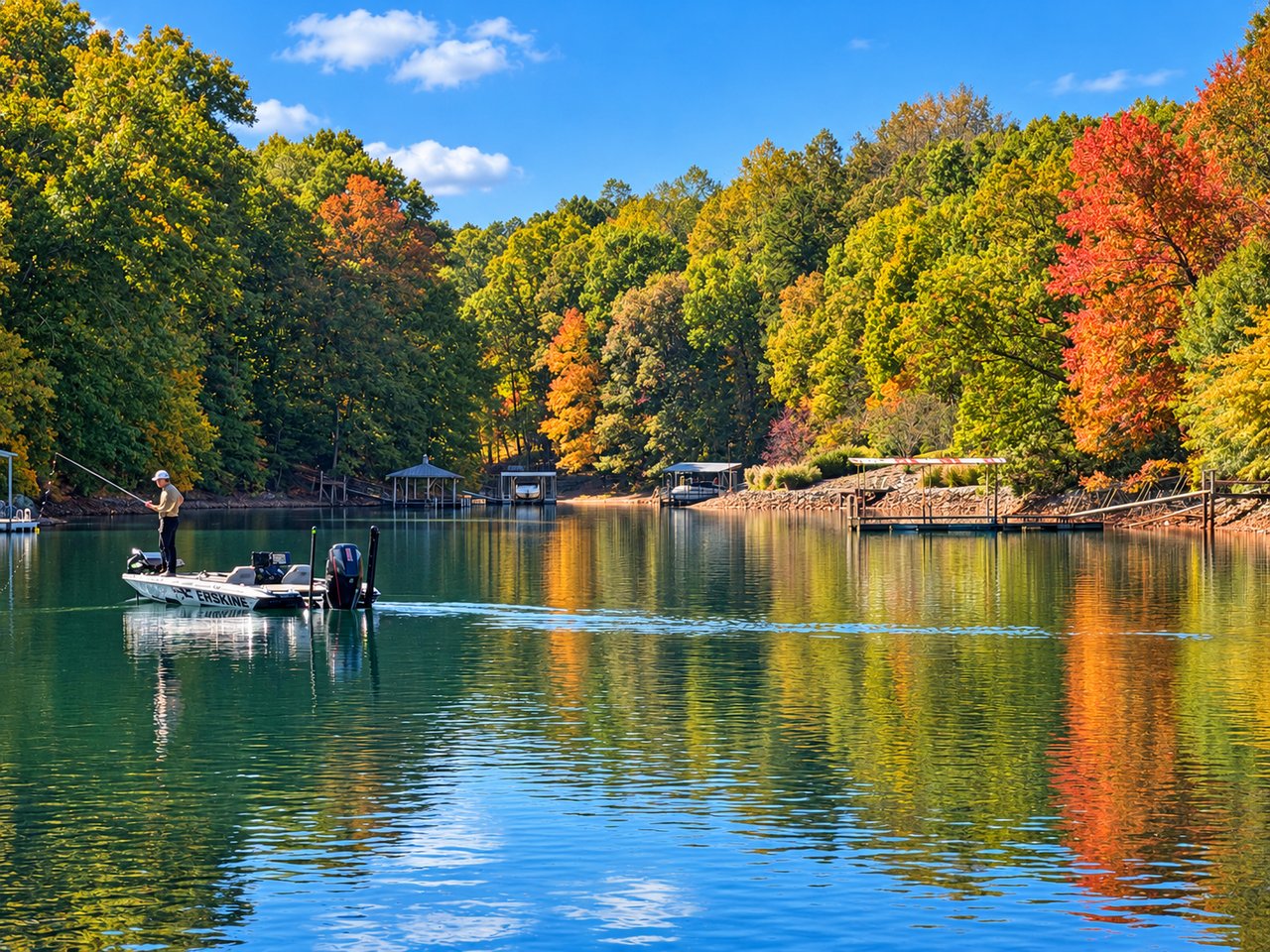
From a dock at Keowee Key, a few feet of exposed bank this November looks like the whole drought story. It's actually the smaller half. Duke operates Keowee and Jocassee as one connected system, and the gap between those two numbers is the system working as designed. Jocassee gives up water so Keowee doesn't have to. That makes the shoreline below Keowee Key a poor gauge of how dry the basin is. The lake to watch is the one in the mountains above it.
Two Lakes Sharing One Supply of Water
Jocassee is a pumped-storage reservoir. According to Duke Energy's description of the Keowee-Toxaway Project, its station generates power by releasing water down into Lake Keowee and can reverse its turbines to pump water back up. Jocassee is also the lower pool for Bad Creek, a second pumped-storage station that moves water between Jocassee and a reservoir higher still.
So when rain stays below normal for months, the water that keeps Keowee near its usual level has to come from somewhere, and much of it comes from Jocassee. The federal license spells out how much room each lake has to give. FERC's 2016 license for the project sets these operating limits:
Lake Jocassee | Lake Keowee | |
|---|---|---|
Full pond | 1,110 ft | 800 ft |
Normal minimum | 1,096 ft | 796 ft |
Normal operating band | 14 ft | 4 ft |
Stage 2 drought minimum | 1,087 ft | 793 ft |
Absolute licensed minimum | 1,080 ft | 790 ft |
Jocassee's normal band is more than three times as deep as Keowee's. The license was written that way from the start.
Keowee Has Jobs That Keep It Near Full
Keowee's narrow band comes from the work it does. The FERC license describes Lake Keowee as the source of cooling water for Oconee Nuclear Station and of municipal water for Seneca and Greenville. Keowee Hydro, the dam's conventional power station, supplies standby emergency power to the nuclear station next door.
The same document says that because of Nuclear Regulatory Commission requirements for Oconee Nuclear Station and other agreements, Duke typically keeps Keowee between 794.6 and 799.5 feet. On a daily average, the lake moves less than a foot and rarely more than 1.8 feet, even when power demand is high.
Keowee has to stay within a few feet of full to do those jobs, and Jocassee holds the water that lets it.
Where Both Lakes Stood in Mid-October
Applied to the full-pond figures in the license, the October 13 committee readings put Keowee at about 796.3 feet and Jocassee at about 1,095.3 feet.
Measured against the floors in the table, those readings mean:
- Keowee was about 0.3 foot above its normal minimum and about 3.3 feet above its Stage 2 drought minimum.
- Jocassee was about 0.7 foot below its normal minimum and about 8.3 feet above its Stage 2 drought minimum.
That is Jocassee doing its job. It had used up its entire normal 14-foot band and had started into the extra depth the drought protocol allows. Keowee, after the same dry months, was still sitting right at the bottom of its usual range.
Stage 2 also caps what can leave the system. Under the Low Inflow Protocol in the license, weekly releases through Keowee Dam are limited to 15,000 acre-feet. That counts hydro units, floodgates, leakage and seepage, and the limit drops further if needed to keep either lake above its Stage 2 minimum. Releases needed for Oconee Nuclear Station operations are exempt.
How the Basin Reached Stage 2
The Low Inflow Protocol has five stages, and this basin has been moving through them for over a year. According to the drought advisory group's release, as reported by FOX Carolina, the stages were declared on these dates:
- Stage 0 on August 1, 2025
- Stage 1 on December 16, 2025
- Stage 2 on Monday, February 2, 2026, the third of the five stages
Stage 2 still held as of the Keowee-Toxaway Drought Management Advisory Group update dated September 17. Based on September 16 data, that update put U.S. Army Corps of Engineers storage at 56.2% and Duke Energy storage at 57.9%. Duke posts each update on its Keowee-Toxaway drought advisory page, and the September 17 update was the newest one listed.
Keowee's protocol is Duke's own plan for its two lakes. Lake Hartwell, downstream, falls under a separate Army Corps drought plan that also covers Russell and Thurmond. That's one reason Hartwell's October reading of 10.57 feet below full pond tells you little about Keowee.
The dry stretch has also lasted longer than any single season. At the October meeting, state climatologist Hope Mizzell said South Carolina last went three straight months without drought in June 2024, The Journal reported.
What Stage 2 Means for a Lakeside Yard
For most lakefront homes, the rule with daily effects is the one on irrigation. The license requires lake neighbors who pump from Duke's reservoirs to water lakeside residential property to limit those withdrawals to no more than two days a week, on days Duke chooses. When Stage 2 began, the advisory group's release named those days as Tuesdays and Thursdays, FOX Carolina reported. Phil Fragapane, Duke's coordinator for the advisory group, said in that release:
"We want to thank residents for supporting water conservation efforts and ask everyone withdrawing irrigation water from Lake Keowee or Lake Jocassee to limit watering to the two designated days per week."
The release also asked all water users in the basin to conserve, and it said large water users would aim to cut withdrawals by 5% to 10% or more. The protocol's table of stage targets sets that 5% to 10% goal for public water suppliers at Stage 2. The goal rises to 10% to 20% at Stage 3 and 20% to 30% at Stage 4.
Any work along your shoreline follows a separate set of Duke rules. Under Duke's shoreline permitting guidance, activities within the Keowee and Jocassee project boundary need prior written authorization, and dock maintenance is among the listed permit types. This post is general information, not legal advice, so check your own property's requirements directly with Duke Energy or the right professional before you pump water or start work at the water's edge.
The Reading to Follow This Winter
Because Keowee is held near its floor, its level will move very little whether the basin is in Stage 2 or close to recovering. Jocassee's reading moves when conditions change. Duke posts both on its lake levels page using a local scale where 100 equals full pond. On that scale, Keowee's normal minimum is 96, its Stage 2 minimum 93, Jocassee's normal minimum 86 and its Stage 2 minimum 77. If Jocassee climbs back toward 86, the reserve is refilling. If it slides toward 77, it is nearing the lowest level Stage 2 allows.
Next on the calendar is the South Carolina Drought Response Committee meeting at 10 a.m. on December 3. In October, the committee voted unanimously to keep Oconee, Pickens and Anderson counties in moderate drought, while it downgraded more than half of the state's 46 counties. In The Journal's account of that meeting, Stuart explained his view: "We just did not get the rain we were hoping for and expecting up in the upper part of the watershed." The state's current county status is posted at scdrought.com.
If you're thinking about what this dry year means for your dock, your shoreline or the photos you'd want for a future listing, David and Thatcher are happy to walk the water's edge with you. Locke & Key Associates is here when you're ready. Let's talk about your home.