Real estate has always been a business built around information. The problem is that having access to information and knowing how to interpret it are two entirely different things.
At Locke & Key Associates, we believe our clients deserve more than a quick search of three or four comparable properties and an opinion about what a home might be worth. Whether we are representing a buyer considering an offer or a seller preparing to put a property on the market, we want the decision to be supported by as much relevant market evidence as possible.
That is why we have developed a much more extensive approach to property analysis—one that combines traditional real estate experience, statistical market analysis and artificial intelligence to examine enormous amounts of information and turn it into something our clients can actually use.
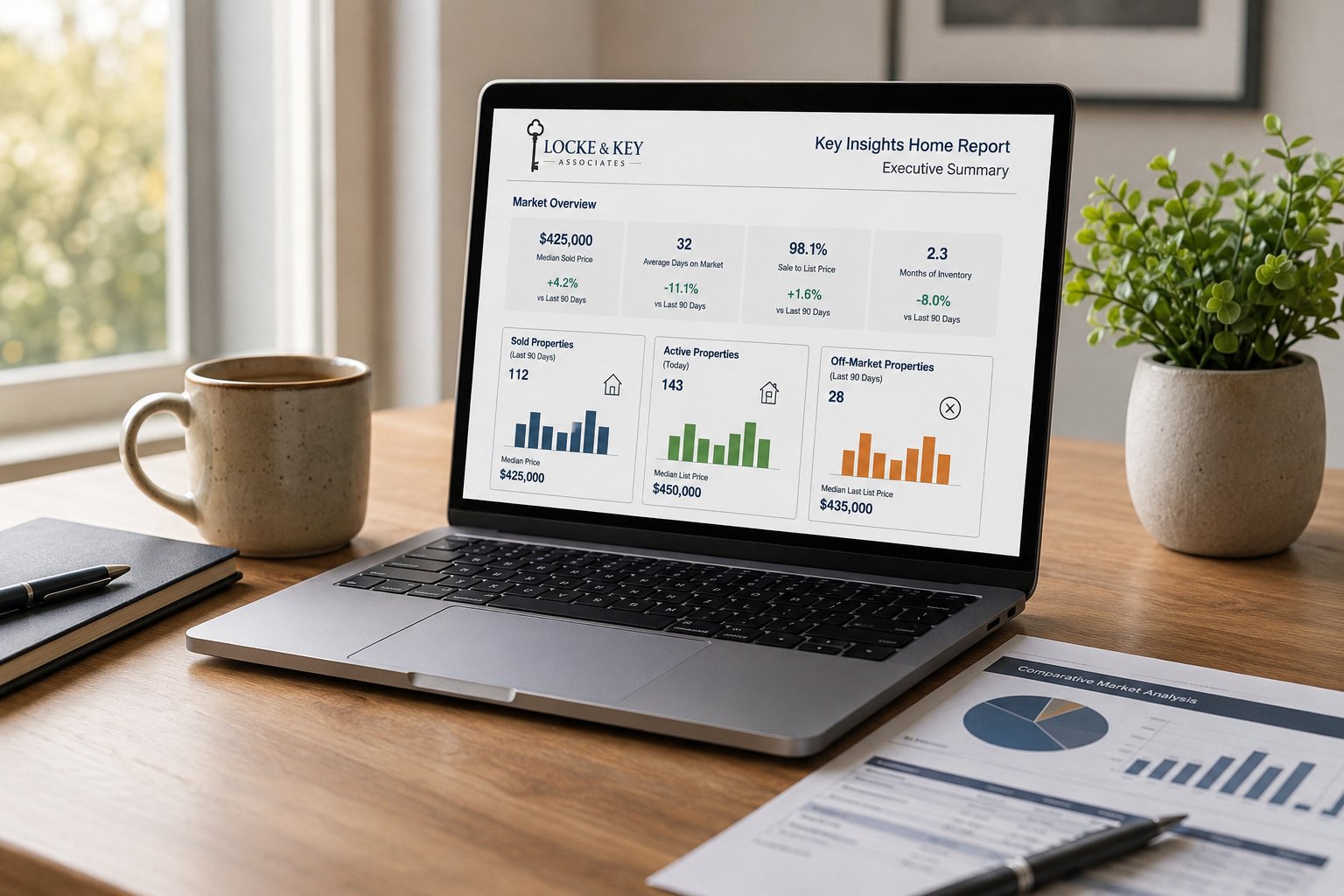
The result is what we call our Key Insights Home Report: an executive-level property analysis designed to help our clients understand not simply what a property is listed for, but what the market is actually telling us about its value, competition and negotiating position.
A Comparable Market Analysis Is Only the Beginning
Most homeowners have heard the term CMA, or Comparative Market Analysis.
Traditionally, a Realtor looks at several homes that have recently sold near the subject property, makes adjustments for differences and develops an estimated value.
That remains an important part of our process—but we believe it should be the beginning of the analysis rather than the end.
A recently sold property tells us what a buyer was willing to pay in the past.
A property currently on the market tells us something different: what today's seller is asking buyers to consider.
And a property that was previously listed but is now off the market may tell us something equally important: what buyers rejected.
At Locke & Key Associates, we want to understand all three.
We Study What Sold
Recently sold properties provide some of the strongest evidence available when determining value.
We analyze relevant sales for characteristics such as location, square footage, lot size, age, condition, renovations, bedroom and bathroom count, architectural style, garage configuration and other features that can influence value.
But we don't simply look at the final sales price.
We also want to know:
How long was the property on the market?
Did the seller reduce the price?
How much did it originally list for?
What was the relationship between asking price and final sales price?
Were concessions involved?
Were there patterns among homes that sold quickly compared with those that remained on the market?
Those details can tell a much larger story than the sales price alone.
We Study What Is Competing With You Right Now
For sellers, one of the biggest mistakes in pricing a home is looking exclusively backward.
Buyers aren't shopping against homes that sold six months ago.
They are shopping against the homes available today.
That means current competition matters tremendously.
If we are preparing to sell a home, we examine other properties a potential buyer is likely to see during the same search. We compare price, condition, location, amenities, square footage, photography, presentation and time on market.
If several comparable homes are available at $400,000, for example, buyers may have little reason to pay $425,000 for another property unless there is a compelling difference.
Understanding that competitive landscape helps us position a property strategically instead of simply placing a price on it and hoping the market agrees.
We Study the Homes That Did Not Sell
This is one of the most overlooked pieces of real estate data.
Sometimes the most valuable comparable is the house that failed to sell.
Expired, withdrawn and otherwise off-market listings can reveal the point at which buyers stopped seeing value.
Perhaps the property was priced too aggressively.
Perhaps it sat on the market long enough that buyers began assuming something was wrong with it.
Perhaps its condition did not justify its asking price.
Perhaps several price reductions eventually followed.
For a seller, those properties can function as warning signs.
They help us identify pricing strategies that the market has already rejected.
For a buyer, they can help reveal opportunities. A home that has struggled to sell—or one competing in a segment where inventory is sitting longer—may provide considerably more negotiating leverage than the list price suggests.
Then We Look for Patterns
The real power of data comes from finding relationships between all of these properties.
Instead of simply asking, "What did the house down the street sell for?", we begin asking deeper questions.
What price-per-square-foot range is the market actually supporting?
Are renovated homes commanding a measurable premium?
Are larger lots producing higher values in this neighborhood?
How much does condition appear to influence the sales price?
At what price points are homes sitting longer?
How frequently are sellers reducing their asking prices?
Which homes are selling quickly, and what do they have in common?
How does the subject property compare with the homes buyers can choose from today?
Those patterns help us move from anecdotal information toward evidence-based decision-making.

Artificial Intelligence Changes What Is Possible
This is where technology has fundamentally changed our process.
A Realtor could theoretically sit down and manually compare dozens—or even hundreds—of property records, calculate price-per-square-foot figures, study listing histories, identify price reductions, compare days on market and look for statistical patterns.
The problem is time.
Parsing that amount of information manually could take days or, on a particularly complicated property, potentially weeks.
Artificial intelligence gives us the ability to process and organize enormous amounts of information far more efficiently.
We can analyze large groups of properties, compare characteristics, calculate relationships and identify patterns that might be extremely difficult to notice when looking at listings individually.
AI does not replace the Realtor.
It amplifies the Realtor.
The technology can help us process information, but experience is still necessary to determine whether that information makes sense.
A computer does not walk into a house and smell pet odor.
It does not notice that one property has an extraordinary sunset view while another backs up to commercial development.
It cannot fully understand why one street commands a premium over another street a quarter-mile away.
It may not recognize that a beautifully renovated kitchen was installed fifteen years ago and is no longer what today's buyer considers updated.
Those are judgment calls.
Our approach combines the processing power of artificial intelligence with local real estate knowledge and human evaluation.
That combination is incredibly powerful.
What This Means for Our Sellers
For our sellers, the objective is not simply to produce the highest theoretical number.
It is to determine the pricing strategy most likely to produce the strongest outcome.
There is an important difference.
An overpriced listing may look attractive on paper, but if buyers reject it, the property can accumulate days on market, require repeated price reductions and ultimately weaken the seller's negotiating position.
We use our analysis to help answer questions such as:
Where does this home realistically compete?
What are buyers currently seeing in this price range?
What price would make the property compelling?
What happens if we price above the market?
How much negotiating room exists?
Which competing properties should concern us?
What improvements could materially affect marketability?
Our sellers are therefore able to make pricing decisions with considerably more context.
We are not simply saying, "I think your house is worth this."
We are showing them why.
What This Means for Our Buyers
The same process can be incredibly valuable when representing a buyer.
The asking price of a property is exactly that—an asking price.
Our job is to help determine how strongly the available evidence supports it.
Before making an important purchasing decision, we can examine recently sold homes, current competition and properties that failed to sell to help determine an appropriate negotiating position.
We look for indicators such as extended days on market, previous price reductions, competing inventory and comparable sales that may support a lower offer.
Conversely, the data may show that a particularly attractive property is priced extremely well and that an aggressive offer is warranted.
Sometimes getting a deal means negotiating below asking price.
Sometimes getting a deal means recognizing value before everyone else does.
The goal is the same: make the decision with information instead of emotion alone.
Turning Thousands of Data Points Into a Simple Executive Summary
One of the most important parts of our process is what happens after the analysis.
Our clients should not have to become statisticians.
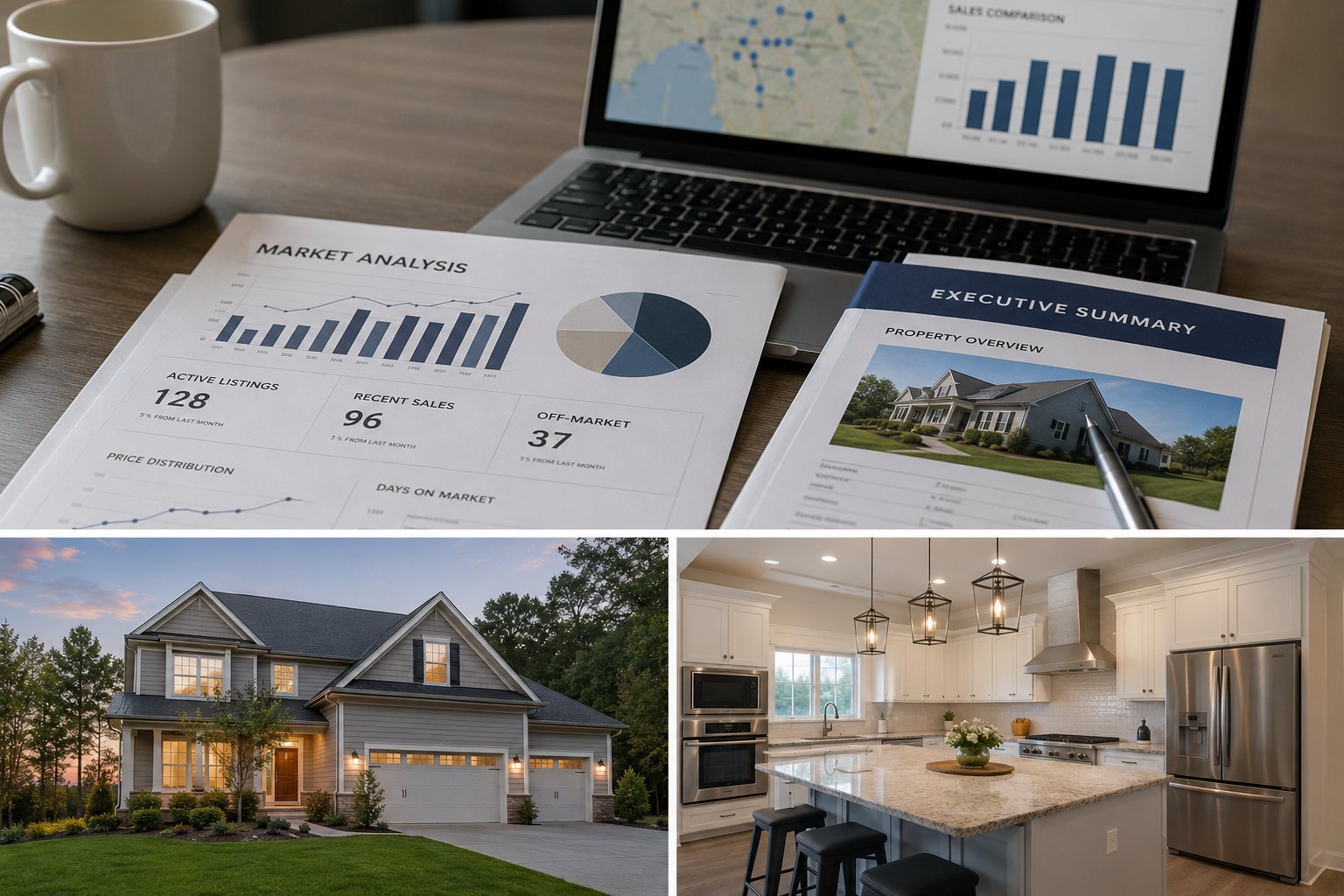
We may work through tremendous amounts of property information behind the scenes, but our job is to translate that information into a clear executive summary.
We want our clients to be able to quickly understand:
Here is what the market is doing.
Here is where this property fits.
Here are the risks.
Here are the opportunities.
Here is the strategy we recommend.
And most importantly:
Here is the evidence behind that recommendation.
That is the difference between receiving data and receiving insight.
Real Estate Decisions Are Too Important to Be Based on Guesswork
For most people, buying or selling a home represents one of the largest financial transactions they will ever make.
We believe the level of analysis should reflect the importance of that decision.
Technology now allows us to evaluate real estate markets at a depth that would have been extraordinarily time-consuming only a few years ago.
At Locke & Key Associates, we are embracing that technology—not to remove the human element from real estate, but to make our advice more informed.
We combine local market knowledge, professional real estate experience, statistical analysis and artificial intelligence to give our buyers and sellers something increasingly valuable:
clarity.
Because pricing is not simply a number.
An offer is not simply a number.
Every number tells a story about supply, demand, competition, condition, timing and buyer behavior.
Our job is to find that story in the data and explain what it means for you.
Whether you are preparing to sell your home or considering the purchase of your next one, Locke & Key Associates can prepare an extensive Key Insights Home Report to help you understand the property, the competition and the market before you make your next move.
Locke & Key Associates
Turning real estate data into decisions.