One South, Many Stories: How Regional Cultures Shape Life, Language, Politics, Migration, and Real Estate Across the American South
There is a saying that “the South” is not one place. It is a collection of places, voices, family histories, food traditions, faith communities, music styles, landscapes, and local identities that can shift dramatically from one county to the next.
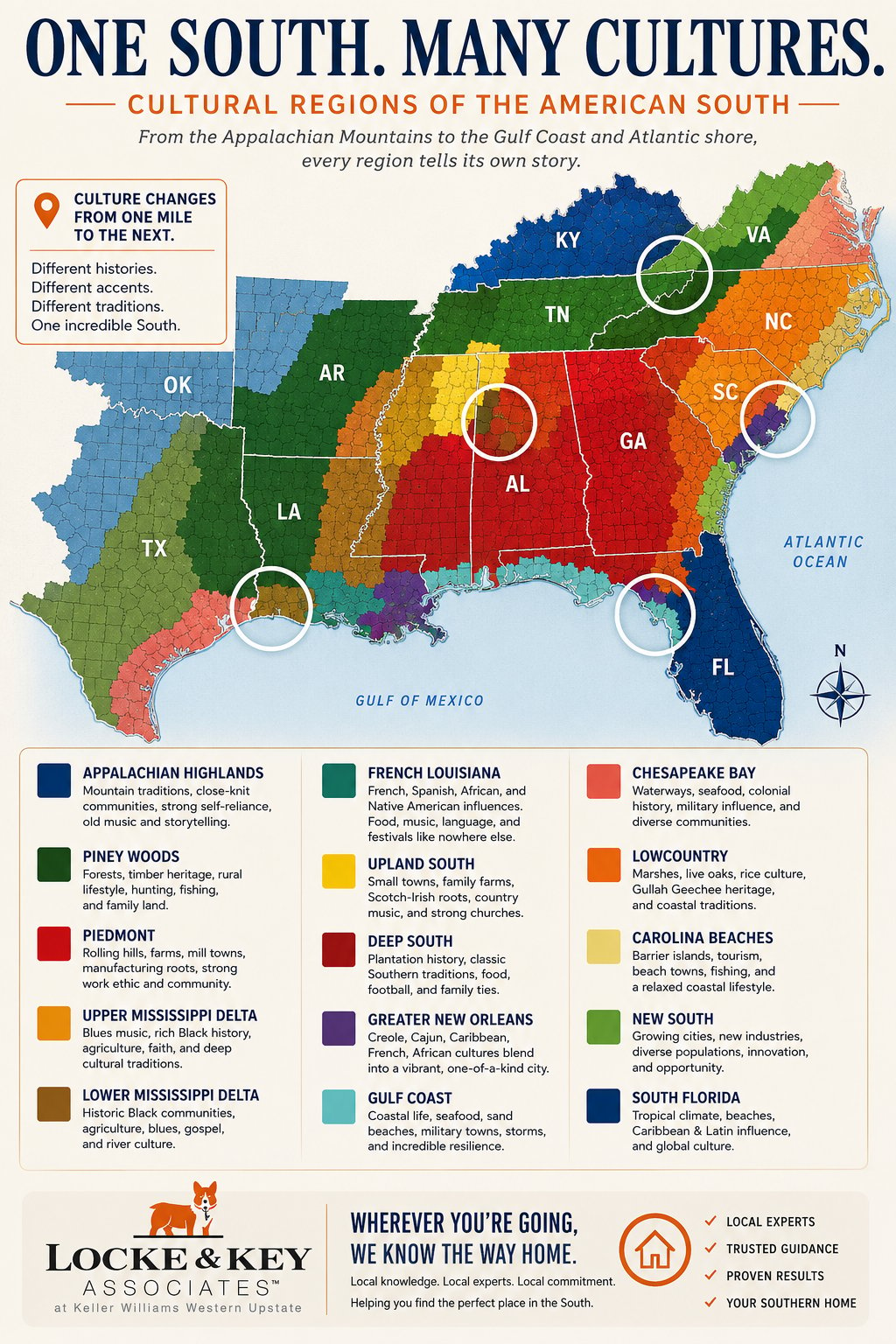
The image above captures something that people who live here already understand: Southern culture is deeply regional. A person can drive an hour and feel like they have entered a different world. The accent changes. The food changes. The architecture changes. The churches may feel different. The politics may lean differently. Even the rhythm of conversation can shift.
For anyone relocating to the South, investing in real estate, retiring here, or simply trying to understand the character of a community, this matters. Culture is not just background scenery. Culture shapes neighborhoods, schools, local business, housing demand, land use, community events, and the emotional experience of calling a place “home.”
At Locke and Key Associates at Keller Williams, we believe real estate is about more than bedrooms, bathrooms, acreage, and square footage. It is about helping people understand place. And in the South, place has layers.
The South Is Not a Monolith
When many people outside the region imagine “the South,” they may picture front porches, sweet tea, barbecue, country music, church steeples, football, warm weather, and a slower pace of life. While those images may be true in some places, they are only a small part of the picture.
The South includes Appalachian mountain towns, coastal fishing communities, former textile mill villages, college towns, rapidly growing suburbs, agricultural counties, military cities, port cities, historic Black communities, Gullah Geechee cultural areas, Cajun and Creole Louisiana, pine forest regions, Piedmont manufacturing corridors, Lowcountry marshlands, and modern Sun Belt metros filled with newcomers from all over the country.
A person moving to Greenville, South Carolina, will experience a different cultural setting than someone moving to Charleston. Anderson feels different from Asheville. Seneca feels different from Savannah. Atlanta feels different from rural Alabama. The Mississippi Delta has a different cultural gravity than the Blue Ridge foothills. The Carolina coast is not the same as the Carolina Piedmont.
That is what makes the South so fascinating.
Why Regional Culture Matters in Real Estate
Culture influences where people want to live, why they move, and what they value in a home.
Some buyers want a walkable downtown with restaurants, festivals, historic buildings, and an arts scene. Others want land, privacy, a workshop, and room for family gatherings. Some want lake life. Some want a mountain view. Some want to be near a church community. Some want a golf course neighborhood. Some want proximity to Clemson, Greenville, Anderson, Lake Hartwell, or the Blue Ridge Mountains.
The South’s regional diversity means there is no single “best” place to live. There is only the best fit for a particular person, family, budget, lifestyle, and long-term goal.
That is where having a local Realtor matters.
A good real estate advisor does not simply open doors. A good Realtor helps interpret place.
Southern Appalachia: Mountain Identity, Independence, and Deep Roots
The Appalachian South is one of the most distinct cultural regions in America. Stretching through mountain areas of states like North Carolina, Tennessee, Virginia, Kentucky, Georgia, and parts of South Carolina, Appalachia has a powerful sense of identity.
This is a region shaped by mountains, valleys, music, storytelling, hard work, family networks, and a tradition of independence. The Appalachian accent is often one of the most recognizable in the South, with speech patterns that preserve older linguistic influences. Bluegrass, old-time music, gospel, and mountain crafts still carry deep meaning here.
Human behavior in Appalachian communities often reflects a strong attachment to land and family. People may value privacy, self-reliance, loyalty, and local trust. Newcomers are often welcomed warmly, but genuine relationships matter. In many smaller mountain communities, people want to know who you are, not just what you do.
From a real estate perspective, Appalachian and foothills areas often attract buyers looking for natural beauty, slower living, mountain views, cabins, acreage, second homes, retirement properties, and outdoor recreation. In Upstate South Carolina, areas close to the Blue Ridge Mountains offer access to hiking, waterfalls, lakes, and charming small towns while still being within reach of larger job centers.
This is one reason communities near the South Carolina mountains continue to appeal to retirees, remote workers, and families who want a quieter lifestyle without being completely isolated.
The Piedmont: The Working Heart of the Carolinas
The Piedmont region, including much of Upstate South Carolina, has its own personality. It sits between the mountains and the coast, geographically and culturally. Historically, the Piedmont was shaped by agriculture, textile mills, railroads, manufacturing, churches, schools, and small-town business districts.
Anderson, Greenville, Spartanburg, Easley, Clemson, Seneca, Powdersville, and surrounding areas all carry pieces of this Piedmont identity. The people here often value practicality, work ethic, neighborliness, and community involvement. The pace is comfortable but not sleepy. The region is growing, but many towns still hold onto a strong sense of local memory.
Accents in the Piedmont may vary widely. You may hear traditional Southern speech from lifelong residents, Appalachian influence closer to the mountains, and more neutral or blended accents from newcomers moving in from the Midwest, Northeast, Florida, Texas, California, and beyond.
This is one of the most important cultural shifts in Upstate South Carolina real estate: migration is blending the old and the new.
Buyers are coming for affordability, climate, taxes, lakes, jobs, retirement, family, and quality of life. Longtime residents are watching communities grow and change. The most successful communities will be those that honor their local identity while welcoming thoughtful growth.
The Deep South: Tradition, Family, Food, and Memory
The Deep South is often associated with states like Alabama, Mississippi, Georgia, South Carolina, and parts of Louisiana and Tennessee. But even within the Deep South, culture changes quickly.
This region carries powerful traditions around food, faith, football, family, manners, music, and history. It is also a region where history is deeply felt. The legacy of agriculture, slavery, the Civil War, Reconstruction, civil rights, and industrial change still shapes settlement patterns, neighborhoods, politics, economics, and identity.
To understand the Deep South, one must understand memory. People remember land. They remember family names. They remember churches, schools, farms, old stores, mills, courthouses, and roads. Stories are often tied to place.
That sense of memory can be beautiful, but it can also be complicated. Southern communities often carry both hospitality and historical pain. A thoughtful Realtor understands that communities are not simply “charming” or “affordable.” They have stories. They have context.
Real estate in the Deep South is influenced by these long patterns. You may see historic homes, generational land, family farms, downtown revitalization projects, old mill conversions, new subdivisions, and rural properties all within a short drive of each other.
The Deep South also has strong emotional pull for people returning home. Many buyers are not just relocating; they are coming back to family roots.
The Lowcountry: Marsh, Memory, Architecture, and Coastal Rhythm
The Lowcountry of South Carolina and Georgia is one of the most culturally rich regions in the South. It includes coastal areas known for marshes, live oaks, Spanish moss, historic towns, barrier islands, shrimping, rice culture, and Gullah Geechee heritage.
The Lowcountry feels different from the Piedmont. The air is different. The food is different. The architecture is different. The pace is different.
Here, culture is shaped by water. Rivers, tidal creeks, marshes, and the Atlantic Ocean have influenced settlement, transportation, foodways, and identity for centuries. Shrimp and grits, oysters, crab, rice dishes, porch living, tabby ruins, historic churches, and coastal festivals all belong to this regional story.
For real estate, the Lowcountry often attracts buyers looking for historic homes, coastal retreats, retirement communities, second homes, resort-style neighborhoods, and walkable towns. But coastal living also comes with practical considerations: flood zones, insurance costs, hurricane exposure, humidity, preservation rules, and environmental sensitivity.
The Lowcountry dream is real, but buyers need guidance. Beauty and risk often live side by side along the coast.
Gullah Geechee Culture: One of the South’s Great Treasures
One of the most important cultural regions of the Southern coast is the Gullah Geechee corridor, found along coastal areas from North Carolina through South Carolina, Georgia, and Florida. This culture descends from West and Central African people who were enslaved on coastal rice, indigo, and sea island plantations. Because of geographic isolation on islands and coastal areas, many African cultural traditions, language patterns, foodways, crafts, and spiritual practices survived with remarkable strength.
In South Carolina, Gullah culture is deeply connected to places like the Sea Islands, Charleston-area communities, Beaufort, and the coastal Lowcountry.
Gullah Geechee culture has influenced Southern food, basket weaving, storytelling, language, music, agriculture, and spiritual life. It is one of the great cultural treasures of America.
From a real estate and development perspective, this region also raises important questions about land preservation, heirs’ property, gentrification, coastal development, and cultural displacement. As more people move to desirable coastal areas, protecting cultural heritage becomes essential.
Growth should never erase the very culture that made a place special.
Greater New Orleans: Creole, Cajun, Catholic, Caribbean, French, African, and American
New Orleans and South Louisiana are culturally unique within the South. This region blends French, Spanish, African, Caribbean, Catholic, Creole, Cajun, Indigenous, and American influences in ways found nowhere else.
The food alone tells the story: gumbo, jambalaya, étouffée, red beans and rice, beignets, po’boys, crawfish boils, and king cake. But culture is also seen in music, architecture, festivals, language, religion, and neighborhood life.
New Orleans is not simply “Southern” in the same way as rural Georgia or Upstate South Carolina. It is its own world. The accent can sound more like Brooklyn than Birmingham in some neighborhoods. Catholic traditions are more visible. Carnival season shapes the calendar. Music is woven into public life.
The human behavior of the region reflects celebration, resilience, creativity, and deep neighborhood attachment. People often identify strongly with their parish, neighborhood, family traditions, school ties, and food culture.
Real estate in this region carries both cultural richness and environmental complexity. Historic homes, raised cottages, shotgun houses, Creole townhouses, and neighborhood architecture are part of the appeal. Flooding, storms, insurance, and infrastructure are part of the reality.
The Gulf Coast: Water, Weather, Military, Tourism, and Resilience
The Gulf Coast stretches through parts of Texas, Louisiana, Mississippi, Alabama, and Florida. Like the Lowcountry, it is shaped by water, but it has a different personality.
The Gulf Coast often blends fishing culture, beach life, military communities, oil and gas influence, port economies, tourism, seafood traditions, and hurricane resilience. Communities along the Gulf often live with an awareness of both beauty and vulnerability.
Culturally, the Gulf Coast is relaxed but tough. People know how to gather, cook, rebuild, and keep going. Seafood boils, boats, beach houses, festivals, and family gatherings are central to the lifestyle.
In real estate, Gulf Coast properties can be attractive for vacation homes, short-term rentals, retirement, and waterfront living. But buyers must understand storm history, elevation, insurance, rental regulations, and maintenance in humid salt-air environments.
The lifestyle is appealing, but due diligence matters.
The Upland South: Borderlands, Blended Accents, and Migration Pathways
The Upland South includes parts of Kentucky, Tennessee, Arkansas, northern Alabama, northern Georgia, the Ozarks, and portions of the Carolinas and Virginia. This region often serves as a cultural bridge between Appalachia, the Midwest, and the Deep South.
The Upland South has historically been shaped by small farms, Scotch-Irish settlement patterns, Protestant churches, country music, hunting traditions, and a strong sense of local identity. It is less plantation-oriented than parts of the Deep South and often has more of a hill-country or small-farm culture.
Accents in the Upland South can vary dramatically. You may hear mountain tones, country drawls, Midwestern influence, and modern suburban speech all in the same region.
Politically, the Upland South has often had its own patterns, sometimes distinct from the plantation South. This is a reminder that politics in the South are regional, historical, and tied to settlement patterns, economics, religion, race, education, and migration.
For real estate, the Upland South has become attractive to buyers looking for affordability, land, lakes, small towns, and access to growing cities like Nashville, Knoxville, Chattanooga, Huntsville, and northwest Arkansas.
The Carolina Regions: A State Can Contain Many Souths
South Carolina alone contains several distinct cultural zones.
In the Upstate, you feel the pull of the mountains, the Piedmont, textile history, Clemson culture, lakes, manufacturing, and Greenville’s modern growth. In the Midlands, Columbia has government, military, university, and central-state identity. In the Lowcountry, Charleston, Beaufort, and the coast carry maritime, Gullah, historic, and coastal influences. The Pee Dee has agricultural, river, and rural traditions that differ from both the Upstate and the coast.
This is why saying “I want to move to South Carolina” is only the beginning.
A buyer might love Greenville but not want Charleston’s humidity and traffic. Another might dream of Beaufort but not feel connected to Anderson. Someone may want lake life on Hartwell or Keowee. Another may want a historic downtown home in Abbeville, Pendleton, or Anderson. Another may want a golf course neighborhood in Powdersville or Brookstone Meadows. Another may want acreage outside Seneca or a retirement-friendly home near medical care and shopping.
The right location depends on the life you are trying to build.
Accents: The Sound of Southern Identity
One of the most interesting parts of Southern culture is language. Accents across the South are not all the same. A Charleston accent differs from an Appalachian accent. A New Orleans accent differs from a Texas accent. A rural Georgia drawl differs from a Tidewater Virginia accent. A Gullah-influenced speech pattern differs from a Piedmont South Carolina accent.
Accents tell stories of migration, isolation, class, race, education, geography, and media exposure. Younger generations may sound different from their grandparents. Newcomers bring new speech patterns. College towns and growing suburbs often develop more blended accents.
In real estate, language matters because it reflects identity. The way people talk about land, home, neighborhood, family, and community reveals what they value.
Some clients say, “I want a little piece of land.”
Some say, “I want to be close to downtown.”
Some say, “I want a place where my grandkids can visit.”
Some say, “I want to get away from traffic.”
Some say, “I want a front porch.”
Some say, “I want to be near the lake.”
Some say, “I want a neighborhood where people wave.”
Those phrases are not just preferences. They are cultural clues.
Politics and Place: Why One County Can Differ From the Next
The map in the image also hints at why politics can change from one place to another. Political behavior is shaped by history, economy, religion, race, education, migration, urbanization, land ownership, and local identity.
A fast-growing suburban county may vote and behave differently than a rural agricultural county. A college town may differ from the surrounding region. A mountain county may have different concerns than a coastal county facing flooding and insurance issues. A historic Black community may have different priorities than a retirement development filled with recent arrivals. A manufacturing corridor may focus on jobs and infrastructure. A lake community may focus on recreation, tourism, property values, and environmental protection.
In the South, politics is often personal because place is personal. People care deeply about schools, roads, land, taxes, growth, churches, local businesses, and the feeling of their community.
For buyers relocating from other states, this can be surprising. Two towns only 20 minutes apart may have very different local conversations.
Migration Is Reshaping the Modern South
One of the biggest stories in Southern real estate is migration.
People are moving to the South for many reasons: affordability, climate, jobs, retirement, taxes, family, lifestyle, remote work, outdoor recreation, and a desire for more space. South Carolina, North Carolina, Tennessee, Georgia, Florida, and Texas have all seen major interest from relocating buyers.
This migration is changing the cultural landscape.
In many Southern towns, you now have longtime locals living beside retirees from New York, remote workers from California, families from Ohio, investors from Florida, and young professionals from Atlanta or Charlotte. This creates opportunity, but it also creates tension.
Longtime residents may worry about rising prices, traffic, loss of farmland, and changes to community identity. Newcomers may bring energy, business, investment, and fresh ideas, but they also need to understand the culture they are entering.
The best relocation experience happens when newcomers do more than buy a house. They learn the place.
They shop local.
They listen.
They respect history.
They support community events.
They understand that “slower” does not mean “less sophisticated.”
They realize that Southern friendliness is real, but relationships still take time.
Food as a Cultural Map
If you want to understand the South, follow the food.
In the mountains, you may find soup beans, cornbread, ramps, apple butter, trout, country ham, and biscuits. In the Lowcountry, you find shrimp and grits, oysters, crab, red rice, okra soup, and Frogmore stew. In Louisiana, gumbo and crawfish tell a story of cultural blending. In the Deep South, barbecue, collards, fried chicken, field peas, pound cake, and pecan pie often appear at family tables and church gatherings.
Even barbecue varies by region. Mustard-based sauce in parts of South Carolina, vinegar-based sauce in eastern North Carolina, tomato-based sauce elsewhere, dry rubs in Memphis, brisket in Texas — each tradition reflects migration, agriculture, taste, and local pride.
Food is one of the easiest ways for newcomers to connect with Southern culture. Go to the local barbecue place. Visit the farmers market. Try the church fundraiser plate. Ask someone where to get the best biscuits. Food opens doors.
Architecture: Culture You Can See
Southern regional culture is also visible in architecture.
The Lowcountry has raised homes, wide porches, shutters, and designs built for heat, breezes, and flooding. Appalachia has cabins, farmhouses, and mountain retreats. The Piedmont has mill houses, brick ranch homes, craftsman bungalows, downtown storefronts, and newer suburban developments. New Orleans has shotgun houses, Creole cottages, balconies, and courtyards. Rural areas may have family land with homes added over generations.
Architecture reveals how people adapted to climate, economy, materials, and social life.
Porches, for example, are not just decorative. They are cultural spaces. A porch is where people sit, wave, talk, cool off, watch children play, drink coffee, and connect with neighbors. In many Southern communities, the front porch is a bridge between private life and public life.
That is why curb appeal in the South often includes more than landscaping. It includes welcome. A home should feel approachable.
Faith, Family, and Community Networks
In many Southern communities, churches remain major social anchors. Even for people who are not religious, church buildings, events, and networks often shape community life. Churches host meals, youth programs, charity drives, funerals, weddings, disaster relief, and local support systems.
Family networks are also strong. In some communities, people live near parents, grandparents, cousins, and lifelong friends. Land may stay in families for generations. Decisions about selling property can involve emotion, memory, and multiple relatives.
For real estate professionals, this matters. A house is rarely just a house. It may be “Mama’s house,” “the old homeplace,” “Granddaddy’s land,” or “where we raised the kids.” Sellers may need patience and respect, especially when selling inherited property or downsizing after decades in one home.
Small Towns and the Desire for Belonging
Across the South, small towns are experiencing renewed interest. Buyers want walkability, historic charm, local restaurants, festivals, farmers markets, and a sense of belonging.
Towns like Anderson, Pendleton, Seneca, Abbeville, Clemson, Easley, and others across Upstate South Carolina offer something many buyers are searching for: connection without the intensity of a major metro.
Small towns are not perfect. They may have limited inventory, older housing stock, infrastructure needs, or fewer amenities than large cities. But they often offer character, relationships, and a slower pace that many people crave.
The key is matching expectations with reality. A buyer moving from a large city may love the charm but need to understand commute times, medical access, school zones, internet availability, and the local job market.
What This Means for Buyers Moving to the South
If you are thinking about moving to the South, do not just ask, “What city should I move to?”
Ask better questions.
What kind of culture feels like home to me?
Do I want mountains, lakes, coast, farmland, downtown life, or suburbs?
Do I want a fast-growing area or a slower community?
How important is walkability?
Do I want historic charm or new construction?
Am I comfortable with humidity, storms, or rural roadways?
Do I want neighbors close by or more privacy?
Do I want a community with lots of newcomers or one with deep local roots?
How close do I need to be to healthcare, airports, shopping, or family?
The South offers many lifestyles, but they are not interchangeable.
What This Means for Sellers
For sellers, understanding regional culture helps with marketing.
A home in Upstate South Carolina should not be marketed exactly like a coastal cottage or a downtown condo. Buyers are not only purchasing the structure; they are purchasing the lifestyle around it.
If a property offers mountain views, proximity to Lake Hartwell, a strong school district, a peaceful rural setting, downtown Anderson convenience, Clemson access, golf course living, or multigenerational potential, those cultural and lifestyle details should be part of the story.
Good real estate marketing speaks to emotion and place.
At Locke and Key Associates, we believe every home has a story. Our job is to tell that story clearly, honestly, and beautifully.
South Carolina: A Special Blend of Southern Cultures
South Carolina is one of the best examples of how many cultures can exist within one state.
In the Upstate, you have mountain influence, lake living, manufacturing growth, college-town energy, and strong small-town traditions. In the Midlands, you have state government, military families, universities, and central access. Along the coast, you have historic Charleston, Gullah Geechee heritage, resort communities, marshland beauty, and maritime culture.
For retirees, South Carolina offers warmth, charm, tax advantages, outdoor recreation, and a lower cost of living than many northern states. For families, it offers a range of communities from suburban neighborhoods to rural acreage. For investors, it offers growth markets, rental demand, and lifestyle-driven real estate opportunities.
But the most important thing is fit.
A person moving to South Carolina should not simply chase a price point. They should find a community that matches their values, pace, and future plans.
Anderson, Seneca, Clemson, Powdersville, and the Upstate Lifestyle
Here in Upstate South Carolina, we sit in a particularly interesting cultural crossroads.
Anderson has history, affordability, Lake Hartwell access, downtown revitalization, and a strong local identity as the Electric City. Seneca offers proximity to Lake Keowee, Clemson, the mountains, and retirement-friendly living. Clemson brings university energy, sports culture, and intellectual life. Powdersville offers convenience to Greenville while maintaining a bedroom-community feel. Easley, Pendleton, Williamston, Belton, and other nearby communities each have their own personality.
This is the beauty of the Upstate. You can be close to mountains, lakes, universities, small towns, farms, and one of the Southeast’s most dynamic cities — all within a relatively short drive.
For people relocating from outside the region, the Upstate can feel like a wonderful balance: Southern culture, modern amenities, natural beauty, and room to grow.
The Human Side of Relocation
Moving is not just financial. It is emotional.
People move because they want to be closer to family. They move because they are retiring. They move because they want a better lifestyle. They move because a job changed. They move after loss, divorce, marriage, children, or a new chapter of life. They move because they are tired of traffic, taxes, snow, or feeling disconnected.
When someone moves to the South, they are not just choosing a house. They are choosing a rhythm.
Will they wave at neighbors?
Will they join a church, club, gym, or civic group?
Will they find their favorite diner?
Will they learn the back roads?
Will they understand Friday night football, lake weekends, farmers markets, garden clubs, and porch conversations?
Real estate is the doorway into a new life.
Growth, Respect, and the Future of the South
The South is growing. That growth brings opportunity, but it also requires wisdom.
Communities need housing, infrastructure, responsible development, preservation, and local leadership. We need to welcome newcomers while respecting longtime residents. We need to preserve cultural heritage while allowing towns to evolve. We need to build neighborhoods that feel connected, not just subdivisions that consume land.
The best future for the South is not one where every town becomes the same. The best future is one where each region keeps its distinct identity while offering opportunity to the next generation.
That means protecting historic downtowns.
Supporting local businesses.
Understanding regional architecture.
Preserving farmland and natural beauty where possible.
Respecting Black history, Indigenous history, immigrant history, Appalachian history, Gullah Geechee culture, and working-class history.
Creating housing options for different stages of life.
Helping people find not just property, but belonging.
Final Thoughts from Realtor David Locke
The image that inspired this blog makes a powerful point: the South is a patchwork of cultures. You can cross a river, a county line, a mountain ridge, or a coastal marsh and find a different version of Southern life.
That is not a weakness. That is the magic.
The South is not one accent, one food, one political view, one landscape, or one lifestyle. It is many stories living side by side.
For buyers, this means you have options. For sellers, it means your property has a story worth telling. For communities, it means growth should be guided by respect for culture and place.
At Locke and Key Associates at Keller Williams, we help people navigate more than the real estate market. We help them understand the communities, rhythms, and lifestyles that make Upstate South Carolina and the greater South such a meaningful place to call home.
Whether you are relocating, retiring, investing, upsizing, downsizing, or simply dreaming about your next chapter, I would be honored to help you find the place that feels right.
David Locke, Realtor®
Locke and Key Associates at Keller Williams
Helping buyers and sellers discover home, community, and belonging in Upstate South Carolina.